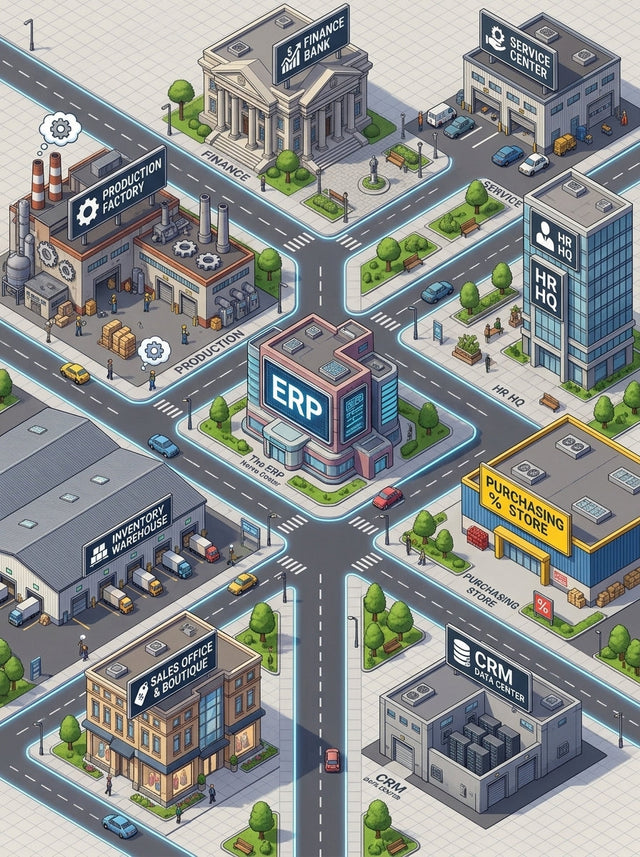
Every serious B2B operation runs on more systems than it likes to admit. There's the ERP that holds the truth about stock, pricing and credit. There's the eCommerce platform your customers actually touch. There's a warehouse or 3PL moving the boxes, an accounts package reconciling the money, and usually a spreadsheet or two quietly holding it all together.
For a lot of wholesalers, manufacturers and trade suppliers, that patchwork works – right up until it doesn't. A price changes in the ERP and takes three days to reach the website. A big trade order lands online and gets rekeyed by hand before the warehouse sees it. Stock says "available" on the product page and "sold out" in the back office. None of it is fatal on its own. All of it, at enterprise volume, quietly caps how far you can grow.
The short version: at enterprise scale, the thing capping your growth usually isn't the storefront – it's the gap between the storefront and everything behind it. B2B ERP integration closes that gap, turning the patchwork into a single fabric where one version of the truth moves automatically between systems. Here's what that actually takes, with real examples from work we've delivered.
What "ERP integration" really means (and what it doesn't)
An ERP integration connects your enterprise resource planning system – the platform that governs inventory, pricing, orders, customers and often finance – to your eCommerce storefront, so data moves between them without anyone typing it twice.
The important word is automatically. Plenty of "integrations" are really scheduled exports: a nightly CSV, a manual sync, someone clicking a button. That's fine for a small catalogue. At enterprise level – tens of thousands of SKUs, hundreds of trade accounts on bespoke pricing, orders arriving around the clock – batch-and-pray falls over. What you need is real-time, two-way sync: an order placed online appears in the ERP instantly; a price or stock change in the ERP reaches the site before a customer can act on stale data.
Get it right and the payoff is operational, not cosmetic. Your team stops rekeying orders. Customers stop seeing prices and availability that aren't real. Finance stops reconciling by hand. And the business takes on more volume without adding more people to paper over the gaps.
Why B2B makes integration harder than B2C
Consumer stores have it comparatively easy – one price, one customer type, pay now, ship. B2B breaks nearly every one of those assumptions, and each break is something the integration has to carry:
- Customer-specific pricing. National accounts, regional dealers and occasional buyers can all see different prices for the same product. The ERP owns those rules; the website has to reflect them per logged-in account.
- Complex ordering. Minimum order quantities, price breaks by volume, sold-by-the-metre or by-the-pallet units, requisition lists and repeat orders – the integration has to move all of it faithfully.
- Credit and terms. Net 30/60, credit limits, accounts on stop. If the website doesn't know a customer is on hold, it'll happily take an order it shouldn't.
- Scale of catalogue. Enterprise B2B catalogues routinely run to six figures of parts. Syncing 100,000+ SKUs reliably is a genuinely different engineering problem to syncing a few thousand.
Here's the difference it makes in practice, across the parts of the operation that actually cost you money when they drift out of sync:
| What's at stake | The patchwork (manual / batch) | Real-time ERP integration |
|---|---|---|
| Orders | Rekeyed by hand from web to ERP | Flow straight through, instantly |
| Stock | Website lags the warehouse; you oversell | One live number, everywhere |
| Pricing | Trade prices updated late or by hand | Account-specific pricing, always current |
| Credit & terms | Storefront can't see who's on stop | Limits and terms enforced at checkout |
| Your team | Reconciling and firefighting | Freed to sell and support |
That's why B2B ERP integration is an enterprise discipline rather than an app you switch on. The value is highest exactly where the complexity is highest.
Mellcrest: keeping Shopify and Intact IQ in perfect sync
Mellcrest is a B2B hotel and hospitality supplies retailer – precisely the kind of business where stock accuracy and trade pricing aren't nice-to-haves, they're the whole game.
They came to us on Magento, and like a lot of Magento B2B businesses, they were spending too much of their budget simply keeping the platform alive: hosting, patching, upgrades, maintenance. We migrated them to Shopify to lower that overhead and simplify the day-to-day – but a migration is only as good as what happens behind the storefront.
The critical piece was the ERP. Mellcrest runs on Intact IQ, and we built a custom Patchworks integration that keeps Shopify and Intact IQ in constant sync – customers, orders and pricing flowing automatically between the two with no manual intervention. An order placed online lands in the ERP without anyone rekeying it. Trade pricing set in Intact IQ is what the customer sees. Stock is real.
The result was a business with lower running costs, far simpler administration, and a platform built to grow rather than one it was constantly propping up. The migration gets the headlines, but the integration is what lets the business actually run on the new platform.
Empee: wholesale fabric, sold the way the trade buys it
Empee – trading as Wholesale Fabrics – is a London-based wholesale fabric house supplying creative businesses: independent makers, online sellers, boutiques and fashion brands. Their range runs from always-in-stock core lines to limited-quantity deadstock and exclusive Empee collections, with fast UK delivery on everything from small cuts to bulk rolls.
It's a textbook case of why B2B stock and pricing data has to be right, in real time. Fabric is sold by the metre with minimum cuts, deadstock exists in genuinely finite quantities, and trade buyers order against their accounts. Sell the same few metres of a discontinued roll twice because the site hadn't caught up with the warehouse, and you've got an unhappy trade customer and a manual apology. The only way that scales is if the system holding stock and the storefront showing it talk to each other continuously.
There's a neat symmetry to it, too: a fabric wholesaler, stitched into its back office through Patchworks. Which is exactly what good integration is – taking the separate pieces and joining them into something that holds together under load.
Why Patchworks – and why the name fits
We partner with Patchworks, a leading integration platform as a service (iPaaS) built specifically for eCommerce. It connects the core systems a retail business runs on – eCommerce platforms, ERPs and 3PLs – through a no-code/low-code layer, so data flows between them reliably and the whole stack can scale without a rebuild every time something changes.
The name is almost too on-the-nose, and we mean that as a compliment. Enterprise retail is a patchwork – an ERP here, a storefront there, a warehouse system, a payments provider, a marketing stack – and the job is to stitch those pieces into one working whole. Patchworks gives us a robust, maintainable way to do that instead of hand-building brittle point-to-point connections that break the first time a system updates. For clients like Mellcrest, that's the difference between an integration that's a one-off project and one that's a durable part of the business.
The pattern behind all of it
Look across the B2B work we've delivered and the same theme keeps surfacing: the platform gets the attention, but the integration is where the operational value lives.
We've built for a B2B catering supplier running 100,000+ parts with a custom ERP integration, because a catalogue that size needs Magento's depth and a sync that won't buckle. We built Club Peroni, a Magento-powered B2B membership and ordering system for Peroni. We delivered Love & Lilah, an eCommerce Site of the Year–winning B2B wedding marketplace. We grew Decorating Centre Online to a 23% increase in B2B customers, and stood up the Gypsum Tools drylining superstore on Magento with SEO migration and ongoing support. At the enterprise end, we run stores for the likes of CDKeys – a global gaming retailer whose Magento 2 build delivered £1.2m of extra revenue in its first three weeks – and support Aqualisa's Adobe Commerce multi-store estate.
Different platforms, different sectors, one constant: none of them run on the storefront alone. They run on the storefront and the systems behind it, kept in sync.
Thinking about your own integration?
If your team is rekeying orders, chasing stock discrepancies, or waiting days for a price change to go live, that's not a quirk of your business – it's an integration gap, and it's costing you more than you think as you scale.
We've been building B2B eCommerce since 2009, on Magento, Shopify Plus, Adobe Commerce and BigCommerce, for brands from startups to £1bn+ operations. And as a Patchworks partner, we can connect the storefront to the ERP, the 3PL and the rest of your stack so the whole thing runs as one.
Tell us about your ERP, your catalogue and your trade pricing, and we'll give you a straight view of what a proper integration would take – and what it would give you back.